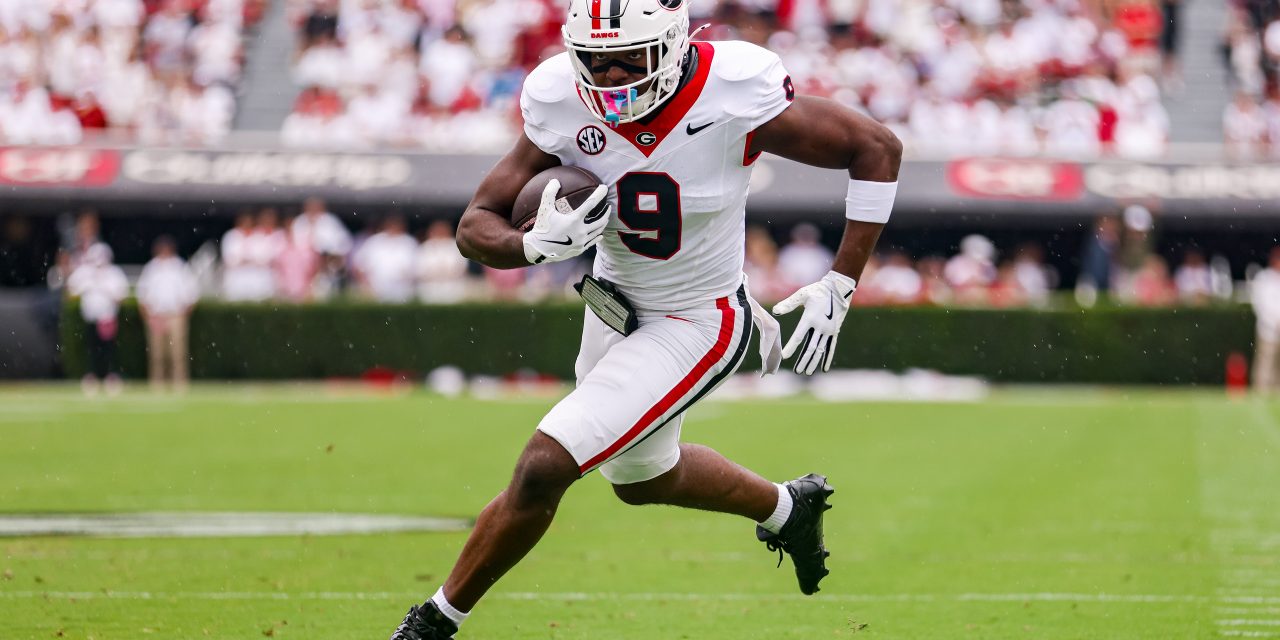
ATHENS, Ga. — When Ethan Barbour finally crossed the goal line on Saturday, he didn’t explode into a celebration or sprint toward the sideline.
He just took a breath — the kind you take when something heavy finally lifts. His first touchdown in a Georgia uniform wasn’t just another score in a 70–20 rout of Western Kentucky. It was the payoff for months of rehab, frustration, and quiet work that started long before anyone saw him stretch the ball across the line.
“It meant a lot to me, just knowing that all the hard work paid off,” Barbour said. “It wasn’t just me. A great play called by Coach Bobo. My receivers were blocking downfield, and we sold the run well.”
He didn’t let the moment turn into a personal victory lap.
“Of course, I got into the end zone,” he said. “I scored a touchdown, but the Dawgs scored a touchdown at the end of the day.”
Staying connected through the injury
Barbour arrived at Georgia as one of the nation’s top tight end prospects out of Milton High School and earned early snaps as a freshman.
Then came the setback.
An injury in 2025 forced Barbour into a long rehabilitation and left his chances of returning that season uncertain.
Plenty of players disappear during injuries.
Barbour didn’t.
“I just love the game, ever since I was a little kid,” he said. “I’ve always just been a happy, energetic person, but I think it’s pretty selfish to just get down on yourself and not be around a team, even though you’re hurt.”
He stayed present, stayed involved, stayed connected. And he attacked rehab with the same mindset.
“Everything was very optimistic about coming back,” Barbour said. “It wasn’t a very, very high percentage that I was, but I just tried to take my rehab as seriously as possible.”
Eventually, Barbour worked his way back in time for Georgia’s College Football Playoff matchup against Ole Miss in the Sugar Bowl, a comeback head coach Kirby Smart still marvels at.
“To come back from that injury that he came back from and to even come back in the same season was incredible,” Smart said. “He came back with the same — there was no timidness. There was no (fear) of contact. He’s proven that again.”
Tight ends coach Todd Hartley echoed that sentiment, pointing to the mindset that carried Barbour through the toughest stretch of his young career.
“How about resiliency, right?” Hartley said this week. “Response. One of the words we use in our room is response. How do you respond to certain situations, whether it’s bad or good? Do you handle praise with humility? Do you handle something bad with resiliency?
“He obviously had a catastrophic injury. Just the way that he worked, even last fall, to get himself in position to come back and start the Sugar Bowl. Think about that. He broke his ankle in game two, and he worked so hard that he started the Sugar Bowl. So that says a lot about that kid’s determination to come back and his resiliency and his response to something bad that happened in his life.”
Finding a role in a crowded tight end room
Healthy again, Barbour is competing in one of Georgia’s deepest position groups. Tight end at Georgia isn’t a position you ease into. You earn your snaps, and you earn them in ways that don’t always show up in the box score.
Barbour learned that quickly.
He joked that his “welcome to Georgia” moment came during bowl practices, when he was still around 230 pounds and asked to block veteran defenders one‑on‑one.
“It wasn’t the best,” he said. “But they definitely let me know what type of time it is when you come to college.”
That lesson stuck. Now he passes it along to younger players: blocking matters, and the ball won’t always come your way.
“You gotta find other ways to make an impact,” he said.
That mentality runs through the entire tight end room. Barbour described the group as having a sense of “mudita” — joy in someone else’s success — even with so much competition for touches.
“Nobody cares how many touches they get, nobody cares how many times they get in the game,” Barbour said. “Everybody just supports one another, and we push one another… we have a lot of great tight ends in our room.
“But nobody’s ever selfish, and we push each other to the max every single day.”
A moment that meant more
Saturday’s touchdown wasn’t flashy.
It wasn’t a trick play or a highlight‑reel grab. But for Barbour, it was a marker — proof that the months of work, doubt, and patience had led somewhere.
After everything it took to get back, the score felt like a reward for the grind nobody saw.
And even then, he didn’t make it about himself.
“Of course, I got into the end zone. I scored a touchdown, but the Dawgs scored a touchdown at the end of the day.” Barbour said.